
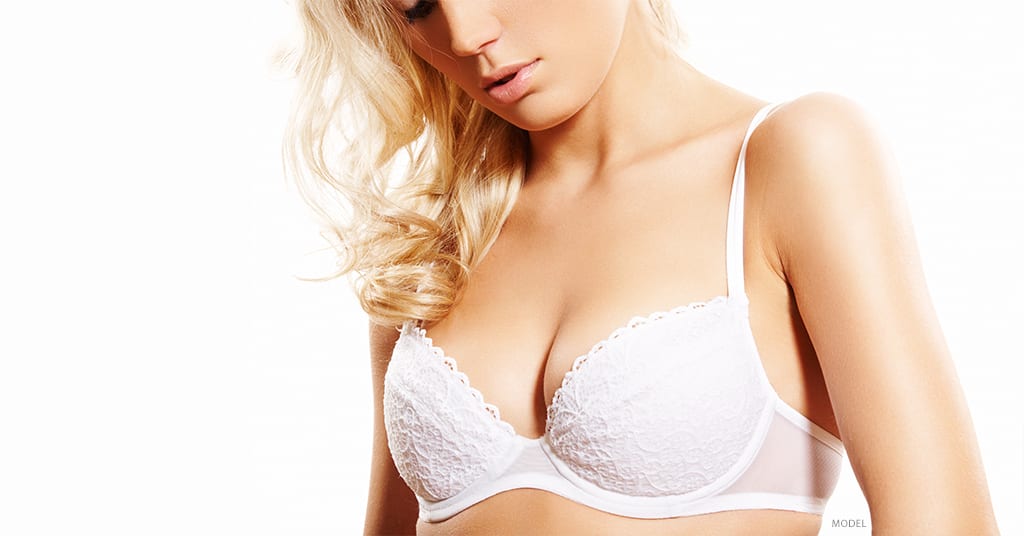
Breast augmentation remains the most popular plastic surgery procedure at my practice and consistently ranks among the top 5 cosmetic surgeries throughout the country. It is a rewarding procedure that allows women to restore or enhance their breast size and shape, boosting their self-confidence in the process.
WARNING:
This feature contains nudity. Please click OK to confirm you are at least 18 years of age and are not offended by such material.


Breast Augmentation Overview
Breast augmentation is an outpatient procedure. I do what is called a rapid recovery procedure, which means that the patient can wake up from surgery with no binding or large dressing. The patient can lift their arms overhead, walk around, go home, take a shower, and go out to dinner and shopping. Patients are back to the gym in 3 weeks. Lifting small children at 1 to 2 weeks is also OK. When it comes to the procedure itself, there are a lot of considerations to determine the best solution for each patient’s situation.
The Consultation
During your breast augmentation consultation, we’ll talk about several issues:
- Your Breast Concerns: I spend time with the patient to understand what bothers them about their breasts. Often, it is something such as the top half of their bra gaps, or their breasts seem to have disappeared after childbearing, or they just want fuller, firmer breasts. Sagging is another common concern, leading us to consider breast lift surgery—alone or along with breast implants.
- Harmony of the Breasts: The biggest discussion I have with patients is explaining that their breasts need to be in harmony before they consider breast implants. Harmony of the breasts means the nipple relates correctly to the breast mound, the breast mound relates correctly to the crease under the breast, and the nipple relates correctly to that crease as well. When harmony is absent, a breast lift may be needed.
- Volume & Skin Envelope Considerations: When breast harmony is good, then we discuss why all A- or B-cup breasts aren’t the same size. The difference lies in how the breast’s volume relates to its soft-tissue envelope. A woman with thicker, tighter, elastic skin and firmer breast tissue is a different preoperative candidate than a woman with thinner breast tissue and stretchier skin.
- Dimension-Based Limitations: I also spend a lot of time discussing how this operation is more dimension-based than volume-based. This means that we need to respect the breast area’s physical or measured limits during surgery. By assessing the breast envelope’s thickness, stretch, and dimension during a physical exam, we can provide a good implant recommendation. I use VECTRA 3D imaging to help the patient see how her body might look after surgery.
- VECTRA 3D Imaging: The VECTRA system uses specialized simulation software to provide breast augmentation patients with 3D previews of potential results using different sizes of implants. The process takes only a few minutes, and patients can review images during their initial consultation and at home on their own computers.
What Breast Implants Are Right for You?
Breast implants are now in the fifth generation and are a more cohesive, or “gummier style implant” than implants 10 or 15 years ago. In most cases, they are not shaped implants; these implants are smooth. They are better at keeping the volume in the upper aspect of the implant when the woman stands up. It still flows, moves, and looks normal, and feels natural. We also have a saline-filled breast implant as an option.
Any implant can be palpated in a woman’s breast, but some feel more natural than others, and I discuss which implant is best for each woman’s breast specifically with each woman. You can learn more about breast implants in our Ultimate Guide to Breast Implants.
The Procedure: Incision Locations and Implant Placement
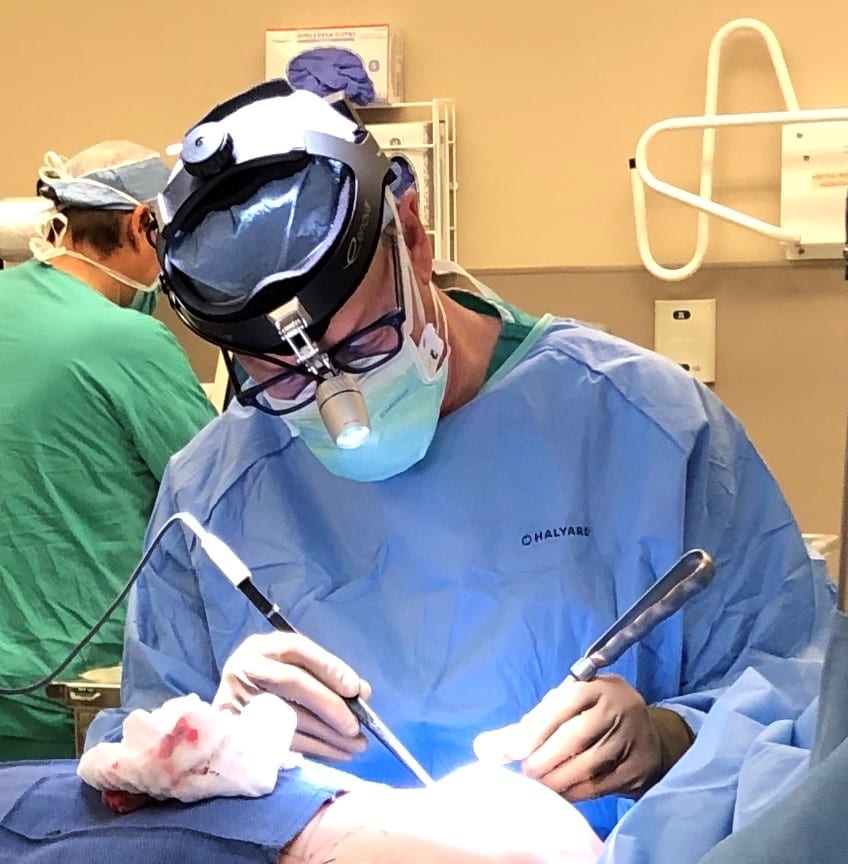
The procedure itself is not very long. It isn’t rushed, and it isn’t rough. No drains are required. A short incision is made either around the nipple area or, more commonly, below the breast in the crease. It could also be placed in the armpit area.
The inframammary or below-the-breast incision offers the most exact placement, which helps preserve the natural borders of the breast and provides an exact placement of the implant. In most cases, the implant is going to be under the breast and under the muscle or behind the muscle. The reason for placing the implant under the muscle is that it looks more natural. There are fewer issues with capsular contracture when we place the implant under the muscle. In a few specific cases, I wouldn’t recommend placing the implant under the muscle, but those are very individual.
Breast Augmentation Recovery & Results
- Rapid Recovery: The operative procedure itself is outpatient. You wake up and go home with a small waterproof dressing over your incision. As I stated above, you can lift your arms up over your head every hour, no bra is required, and you can take a shower and go out to dinner.
- Pain & Medication: We use numbing medicine in the surgical area as we operate to make the patient more comfortable. We even have numbing medicine that can last 2 or 3 days as an option. All of our patients take Motrin if they are allowed for about a week, and some prescription medicine for a day or two if necessary.
- Results: The results are essentially immediate, but the actual, natural look of the breasts takes 3 to 6 months, depending on the patient. That said, patients are very happy almost immediately with their new look. Long-term follow-up is recommended, and I prefer to see all my patients yearly. In the near future, we will have high-resolution ultrasound to image the patients’ breast implants during follow-up.
Dr. Colville is one of the leading breast augmentation specialists in the nation. Breast augmentation patients travel to his Toledo, Ohio, practice from throughout the region to have him perform their procedures. If you’re thinking about getting breast implants, contact us using the online form to request a personal consultation or call us at (419) 534-6551 to schedule an appointment.